Songs of Summer: Psalm 127
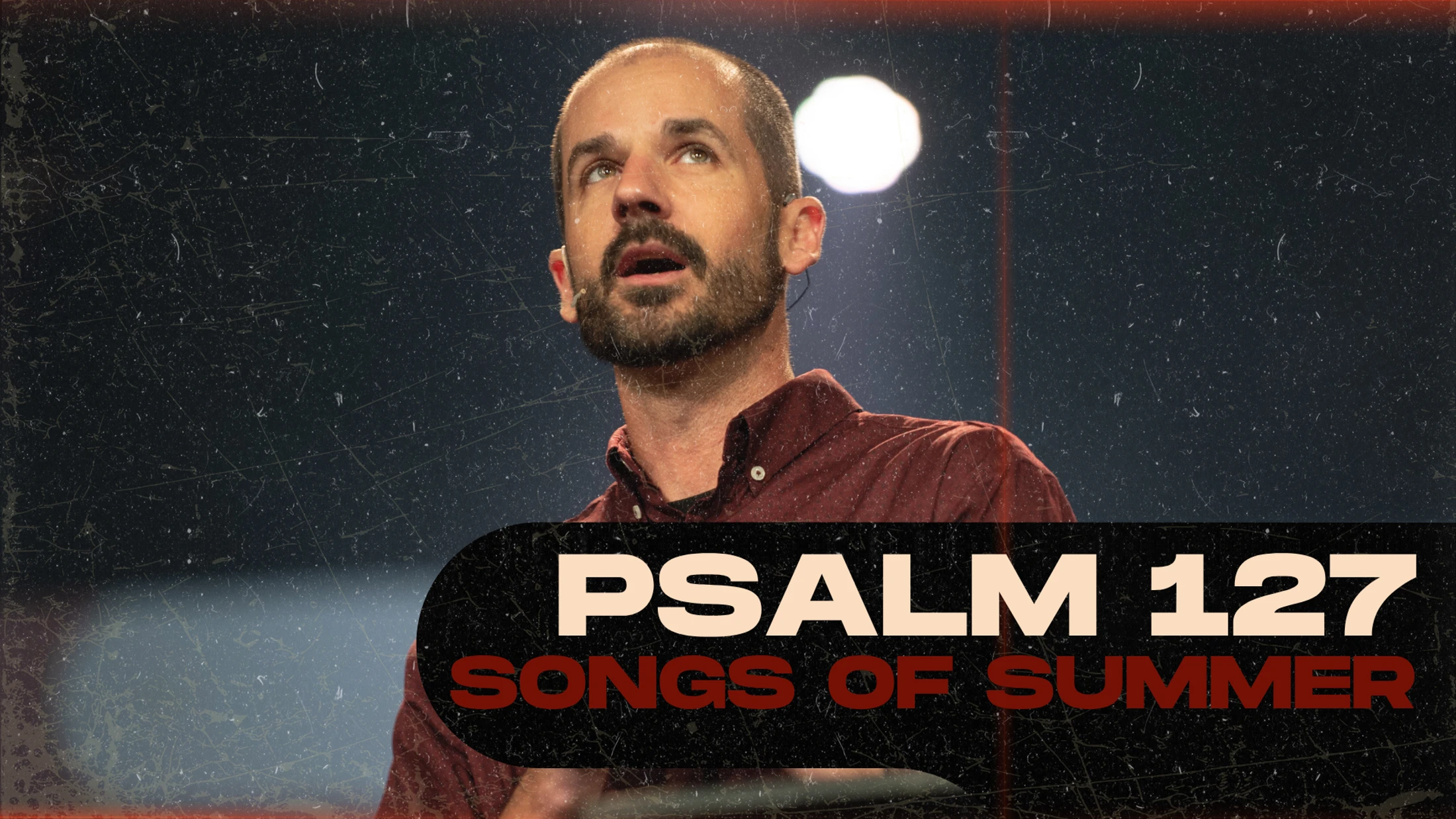
It's Father's Day. Happy Father's Day. There we go. Everybody's glad for fathers now. Well, Father's Day carries a lot with it, doesn't it?
Because there are all kinds of fathers, all kinds of fathers. There are soon to become fathers. There are fathers at all different stages of raising kids. Fathers who are empty nesters, fathers who are who have lost a child, fathers who have become grandfathers and great grandfathers. There are good fathers and terrible father fathers.
There are absent fathers, fathers that maybe we've never met, stepfathers, spiritual fathers, young fathers, not so young fathers, those who wish they could be fathers, those who chose to be fathers by way of adoption, and those of us who. Who no longer have our fathers. And whichever of these fathers you have or have had or are or want to be today, I just want to say that we, as your church family, we celebrate you. We grieve with you and struggle alongside you. We mourn with you and we pray with and for you.
And no matter which of these fathers that you are or have experienced, I want you to know God is a perfect father.
And his perfect design for earthly fatherhood purpose is purposely intended to be a beautiful reflection of himself. So to the fathers in this room today, when you are at your best, you are a clear, tangible, poignant picture of God's love and character to your kids. And when you are at your worst, you are fracturing the lens through which they see God. Dads, don't miss this. Your role as a father is designed by God to be a role that shows his love and his character to your kids.
How they view you is in major part forming how they view him. Let me say that again. How they view you is in major part forming how they view him. This is a tremendously high responsibility. You know, there are only really two commandments in the Bible for dads, like direct commandments for fathers.
There are lots of them for parents in general, but only two that I could find for fathers, none directly to mothers. And in fact it's really only one because it's the same one on repeat twice. I think it might be because God knows that this command represents a really easy pitfall for us as dads. I also think because it's because behind it is something really significant with a reality that has a deep consequence. So here's the command.
It's found in Colossians 3:21. Fathers, do not provoke your children lest they become discouraged. And Ephesians 6:4, Fathers, do not provoke your children to anger, but bring them up in the discipline and instruction of the Lord. See, especially as men, we have a very high tendency to be harsh, to be cutting, to be ungentle, to be, to be provoking with our correction, our joking, our jeering, our frustration and our discipline. And the unfortunate reality is that all this has long term effects on our kids.
And all of this over time is forming their view of God. Dads, I want to be clear, this isn't what Matt Chandler would call a drive by shaming, okay? This is just a reality check. It's a reality check for us today because there's a lot at stake. Paul David Tripp, he's an author and preacher.
He wrote a small book called Awe a W E. And in it he says something very poignant to parents today. Fathers, I'm asking you to join me in being very convicted by his words. I'll read them now. You have been chosen to visibly represent the authority of God on earth in the lives of your children. You are the look on God's face.
You are the tone of his voice. You are the touch of his hand. You are his character and attitude. This means that every time you exercise authority in the lives of your children, it must be a beautiful picture of the patient, firm, gracious, wise, loving, tender, merciful, forgiving and faithful authority of God. Why?
Because your job is to leave your children in awe of the stunning, rescuing beauty of God's authority. Your job is to be used for God to help your children move from natural rebels against any authority but their own to those who are in awe of God's authority. This means that every time your authority is exercised in a selfish, impatient, irritable, name calling, abusive, partial or condemning way, you are not part of what God is doing in the life of your child. You are in the way of it. When you express your authority in this way, you don't lead your children to stand in in awe of the beauty and helpfulness of God's authority.
No, you help deepen the natural rebellion your child has toward it. You see, if my child has an awe problem in his art and I have been sent to visibly represent the God who should be at the center of his awe capacity, then the manner in which I respond to my child affects the way he views God himself.
You know, before I was married, I thought, I'm a pretty decent person. I'm not that selfish, I'm pretty patient. And then my wife became a giant mirror for me to see just how selfish and impatient and broken I actually was. And then eight and a half years later, when we had our first child, I thought I'm a decent person, I'm pretty patient, I'm not that selfish. And then my three children became an even larger and even clearer mirror to show me just how broken and impatient and selfish I actually am.
Actually am. Dads, I need you to know today that I stand in front of you as a guy who regularly feels ill equipped and insecure. As a father, a guy who too often fails to give my kids a beautiful picture of God's love for them. And if you don't feel this way regularly too, if you don't have this same problem, then you are either a liar or I need to know your schedule because you need to preach and we need to hear what you have to say.
Moms, Dads, there is a reason this work is so hard. It is because we are at war. It is because Satan is working with full force to make it as hard as he possibly can. It's because he knows that if he can trip us up, then he can tarnish or maybe even completely destroy our kids view of God. So I want to pray over all of us right now.
Fathers, mothers, grandfathers, grandmothers. I want to pray. Will you join me Lord this morning? For fathers and mothers and grandfathers and grandmothers, we pray joy for not yet fathers hope for single fathers, grace and providence.
Please bring comfort and hope today to the fathers of prodigals, the fathers who have already lost their children, the fathers who don't know where their children are.
Please bring grace in place of shame for fathers who feel ill equipped for fathers in prison, for fathers who feel they've failed, for fathers who can't be with their kids, and for fathers who have given up their children or given up on their children.
And for those fathers who have lost their child in death or maybe never even met their own child. Please bring comfort and healing for those of us who had fathers that pointed us to you. Lord, we thank you. We thank you. What a gift.
For those of us who have deep wounds and brokenness because of our fathers. Lord, please remind us that you are a perfect father and help us not to project our father's shortcomings onto you.
Remind us that we can break the cycle of generational brokenness and sin. Lord, thank you for the gift of fathers. Biological, adoptive, spiritual, protect, strengthen, equip, raise up and encourage the fathers who are listening right now and call them out by your spirit to carry this great responsibility beautifully, even in their insecurity, even in their failure, even in their brokenness, even as the enemy seeks to steal and kill and destroy and disrupt. It's by the powerful name of Jesus, by the same power that raised Christ from the grave, that I pray this. Amen.
Well, today we're looking at Psalm 127 as part of our Songs of Summer series. And I've been hearing some great stories about the impact of these messages of being in the Word, of studying this together. Great stories about being in the devotionals together as a family. If you have missed out on the devotionals, we still have some left. You can grab them at the exits, at the info desk, at the kids check in as well.
There's also a digital version online if you would like to access that as well. But today, like I said, we're in Psalm 127. And I chose Psalm 127 for today because it talks about the household and it talks about children. It's a shorter psalm, only five verses in total. And in your Bible, it probably has a little superscript at the top that says a Psalm or Song of Ascents.
And then it will likely attribute the psalm to King Solomon as well, who was David's son. King David's son. The Bible says that Solomon was the wisest person to have ever lived. But let's look at this phrase, a Psalm of Ascent. The Psalms of ascent are 15 Psalms, chapters 120 through 134, that were traditionally sung by the Jews at least three times a year as they traveled to Jerusalem, the ascent up to Jerusalem, because Jerusalem was at a high point.
These Songs of Ascent were there so that they could be kind of a history book of God's faithfulness. But they would also be something to pass time as they came along and a way to get their hearts ready for worship at the Temple. I'll be honest, the road trips that we take as a family aren't quite as holy as as that. They're not usually filled with singing scripture together. I'm sure that your family is much holier than mine, but quite frankly, it's hard enough to make it to Costco and back without a fight breaking out in the backseat.
But let's read Psalm 127, then we'll kind of pick it apart a little bit and see what we can find here. Psalm 127 unless the Lord builds the house, the builders labor in vain. Unless the Lord watches over the city, the guards stand watch in vain, in vain. You rise early and stay up late toiling for food to eat. For he grants sleep to those he loves.
Children are a heritage from the Lord. Offspring a reward from him, like arrows in the hands of a warrior, are children born in one's youth. Blessed is the man whose quiver is full of them. They will not be put to shame when they contend with their opponents in court or when they argue at the gate. Some translations say.
Now this chapter opens with three things that Solomon says that if we do them in a particular way, they are in vain. And this word in vain most often is translated as falsehood or deception or false vision. We might say your lies to yourself. If you do it in this way, you're lying to yourself. He says to try and build a house.
And this word house can literally mean a house or a home or a household, which would include the entire family and their belongings. But to try and build a household without God's help is to build it in vain to lie to yourself. Second, he says to stand guard or try to protect the city. This word city can mean anything from a small encampment all the way up to a giant city. But to try and protect what you have built without God's help is to do it in vain, to lie to yourself.
And then third, he says that it's in vain to get up early to work extra and stay up late to work extra so that you can toil for food to eat. Other translations say to eat the bread of sorrows. All this is describing someone who is doing what most of us would think of as really good stuff, right? Working to build a home, working to protect what has been built, getting up early and staying up late to work hard and put food on the table. But Solomon doesn't say that these things in general are the problem.
He says that to do them by ourselves, on our own, without God, God is all in vain. You might remember that King Solomon was blessed by God. That's what he asked for, was wisdom. God said he offered him what he was wanting. And Solomon said, I want to be wise above all things.
And so God blessed him with that. This wisdom wasn't just the kind of wisdom that allowed him to make good decisions either. First kings first. Starting in verse 29, we read, and God gave Solomon wisdom and understanding beyond measure and breadth of mind, like the sand on the seashore. So that Solomon's wisdom surpassed the wisdom of all the people of the east and all the wisdom of Egypt.
For he was wiser than all other men, wiser than Ethan the Ezrahite and Heman and Chalcol and Darda the sons of Mahol. And we all know how wise they were.
And his fame was in all the surrounding nations. He also spoke 3,000 proverbs and his songs were 1,005. He spoke of trees, from the cedar that is in Lebanon to the hyssop that grows out of the wall. He spoke also of beasts and of birds and of reptiles and of fish. And people of all nations came to hear the wisdom of Solomon, and from all the kings of the earth who had heard of his wisdom.
See, Solomon was given understanding and knowledge of all kinds of things, from architecture to science and economics to warfare, mathematics to botany and medicine and zoology. You also might know about Solomon that he wrote the book of Ecclesiastes as well. And he wrote this book later on in life, and in it he shares the that he chased after every worldly pleasure that existed, every worldly gain. He tried to find meaning in anything that the world could offer him. And at the end of his pursuit, all this toil, all this striving, all of this stuff, he called it all meaningless.
He called it vanity.
Ecclesiastes, chapter two tells us this is Solomon speaking. He says, I undertook great projects. I built houses for myself and planted vineyards. I made gardens and parks and planted all kinds of fruit trees. In them I made reservoirs to water groves of flourishing trees.
I denied myself nothing my eyes desired. I refused my heart no pleasure. My heart took delight in all my labor. And this was the reward for all my toil. Yet when I surveyed all that my hands had done and what I had toiled to achieve, everything was meaningless.
A chasing after the wind. Nothing was gained. Under the sun. Solomon amassed an incredible amount of wealth. Historians believe that in today's dollars, it would be about $2.2 trillion dollars.
None of us have that much. So for context, if you do, we should talk. But for context, that is more money than the combined wealth of Elon Musk, Jeff Bezos, Bill Gates, Mark Zuckerberg, and more than 10 other most rich people in the entire world. This is a lot of money, right? He built literal cities, he built palaces, he built the temple in Jerusalem.
This is a guy that knows what it takes to build something. This is a guy that understands what it takes to protect and preserve something. He understands what hard work looks like. And he says that all of it is in vain without God. Now, this idea of getting up early and staying up late to work isn't talking about just having enough to eat.
This is saying that there comes a point when we toil and work and toil and work, and we may well have food to eat. But even as we eat it, even as we enjoy the stuff, we are in sorrow because it doesn't ever satisfy. Men especially. Let me talk to you for a minute. Cause we have a high temptation to give in to this.
If you're working 60, 70 plus hours a week, toiling away so that you can have a nice truck, a big boat, go on vacations, fill in the blank, and at the same time you're telling yourself that it's for your family, then you've fallen into the trap of toiling in vain. I'm not talking about a season of heavy workload. I'm not talking about. I'm not saying it's bad to have nice things. I'm talking to those of us who have convinced ourselves that working 70 hours a week is somehow a badge of honor.
I'm talking to those of us who tell ourselves that it's for them. Who tell ourselves that our wife and kids just don't get it when they tell us that they wish we were home more. Who tell ourselves that we're too important to not have to work while we're on vacation. I'm talking to those of us who trade nearly every early morning and every late evening and every Saturday, working and working and working, all to buy some toys or to get a promotion, or for a nice trip, or for power or significance or whatever it is. Because when we gain all of that at the expense of our marriage, at the expense of our walk with God, at the expense of our relationship with our kids, then we toil completely in vain.
We lie to ourselves. We fool ourselves into believing that the whole thing depends on us. And Solomon, who lived it all, said, it's not worth it. In fact, he says, God gives sleep or rest to those whom he loves. Maybe this is the one thing you needed to hear today.
Don't fall into this trap. Don't lie to yourself.
Then we pick up in verse three, children are a heritage from the Lord, offspring a reward from Him. Like arrows in the hands of a warrior, are children born in one's youth. Blessed is the man whose quiver is full of them. They will not be put to shame when they contend with their opponents in court. Now, at first glance, it kind of looks like Solomon took a hard left turn, like.
Or maybe he's on to something else. He was talking about building and protecting and working, but now he's talking about kids. But I think there's a consistent thread running through this whole Psalm. Remember verse one? He said, unless the Lord builds the house, the builders labor in vain.
Unless the Lord watches over the city. The guards stand watch in vain. You may have already picked up on this, but it didn't say, don't labor in building. God will take care of that. It doesn't say, don't watch over and protect what's been built.
God will take care of that. It's a partnership. God is building the house, and we work alongside him. God is doing the protecting and we protect alongside him. God is watching over the city, and we watch alongside him.
And then the next section brings us to another thing that we might believe we are producing on our own. Children. We did the work, so to speak. I think we all know how kids got here, right? This is saying that even if we believe that we are the ones choosing to build our household, God is the one who has blessed us with the gift of children.
And then he says, the children are like arrows in the hands of a warrior. And blessed is the man whose quiver is full of them. Now, I'm quickly running out of time. There is a ton in here that we could cover. But since it's Father's Day, I want to hone in on one thing.
It's something that doesn't seem to be the main character. It looks like the main character here is the arrow or the arrows or the quiverful of arrows, but hiding in this sentence is another character. It's the warrior.
There's another whole sermon to be preached on the arrows, about how to build them, to straighten them, sharpen them, about the importance of the stiffness of the spine of the arrows, about the fletching and its purpose in keeping the arrow flying straight and true.
There's a ton there to unpack, and I might do that on another day, but right now I'm going to zoom in on the one who holds these arrows in his hand. Fathers, do you know that you are at war? Do you know that you are at war? That's what a warrior is, right? One who is at war.
You are at war, whether you know it or not. You have a bow in your hands. And if you have a child or children, then you have arrows in your quiver. But how much are you prepared yourself as the archer, as the warrior, to have the strength and knowledge to loose those arrows you have been given as a gift. On YouTube, there's this really interesting video.
It's a guy who is an archer, and with him are these big giant bodybuilder guys, like super jacked, kind of like me, you know, way bigger than the skinny kid and the guy who owns the bow, he's a pretty normal looking guy, and he picks it up and he draws and he shoots the arrow. And then he hands it to one of the bodybuilder guys, and it's almost laughable. The bow looks small in his hands because he's giant, right? And the big, giant bodybuilder guy, he struggles and grunts and groans, and he cannot pull back this bow. It's pretty hilarious.
Why? Why can't the giant guy with the giant muscles draw the bow? There's two reasons. One, he has strengthened and built up the wrong muscles. It takes an entirely different set of muscles to pick up heavy things than it does to draw back the heavy weight of a bow.
And two, he has the wrong technique. Drawing the bow isn't about brute strength. It's also about form. It's about technique, having big muscles, even owning a bow and arrows do not make you an archer or a warrior. Dads, I want you to see this.
God has given us children to raise, to form, to harden, to sharpen, to straighten, and to care for. But if, when the time comes for this quiver of arrows to be fired off, are we going to be a skilled archer or warrior and ready to do our part? Because if we're not, then their potential as an arrow at best will not be what it could be. And at worst, it might be completely wasted altogether. I'm not talking about them becoming successful by the world's standards.
I'm not talking about them becoming a football star or getting scholarships or making straight A's. I'm talking about them hear this. Being used as a weapon for the kingdom of God against the kingdom of the enemy. Because a beautiful, sharp, perfect straight arrow that never has a target and never takes flight is a wasted arrow. And let me ask you this.
Do your arrows feel more like a burden or a blessing? Is the work of sharpening and straightening? Is it more of a job or is it a joy? Is the sound of them constantly rattling in your quiver more obnoxious? Or is it beautiful when they sometimes fall out and they need to be repaired?
Is it more of a job or a joy when you practice with them and the fletching comes off and it needs replaced? Are you complaining or are you investing? And every once in a while, when you pick them up to care for them and you get cut because they're sharp, do you drop them or break them in frustration, or do you hold them more carefully?
I cannot tell you how much I needed to ask myself these questions as much as I needed to ask them of you today. The truth is, I have A lot more work to do with these arrows in my quiver to take care of them, to enjoy them while they're in my care, to hold them more carefully in my hands. And the truth is, it's exhausting. It's frustrating. It's complicated.
It's hard. But, dad, you are at war with a very real enemy. And it's time that we stop our vain toil and working and building and protecting. It's time that we stop using excuses. It's time that we fix our eyes on God and care for these arrows well, so that when the time comes, when God says it's time to send them flying as a weapon, not only will they be ready, but we will be ready, too.
So, Dads, here's my challenge. Here's my challenge. If God has already convicted you with something to do today, do it. Do it. If you saw a problem at work, you would figure it out and you would do something about it.
If you see a problem in your home, do something about it. And if God has not already convicted you of something, then ask. Ask. Ask him. And I think he'll be faithful.
I believe he will be faithful to reveal it to you. And if you're really brave, ask your kids how you're doing. Ask them what they think you could do differently to encourage them to care for them, to sharpen them, to love them.
Wives, hear me out. You are not the Holy Spirit.
In fact, you make a lousy Holy Spirit. No man has ever come to me and said, you know, I wasn't sure what to do. But then my wife kept reminding me over and over and over and over. And then I saw my flaws, and I joyfully realized what I needed to do.
Instead of this, do two things.
Pray for him. Pray for him every day. Pray for him. And the second. Become an expert in his strengths rather than his weaknesses.
So that you can cheer him on because he's at war, too.
Cheer him on while he trains, while he works, while he practices, while he puts band aids on his hands from the cuts of picking up the arrows, while he becomes a greater and greater warrior. Unless the Lord builds the house, the builder labors in vain. Unless the Lord watches over the city, the guards stand watch in vain.
So towards the end of Solomon's life, after he had finished all this building and chasing after pleasure and striving for significance, here is his conclusion. At the very end of Ecclesiastes, chapter 12, verse 13, the end of the matter, all has been heard. Fear God and keep his commandments. For this is the whole duty of man fear God and keep his commandments. Let's pray.
Perfect Father, we quake in front of you.
We have so much to work on and so many of us men are just keeping our chest up and we're keeping our head up and we keep grinding and grinding and grinding and we come up with a hundred reasons why we can't do this or ought to do that or have to do this or whatever it is.
And I pray that you would just break through all that, That you would help us to train, to care for, to sharpen, to strengthen, Lord, because we're your warriors.
We're your warriors. So help us to see that today convict us deeply, Holy Spirit, of the next steps that we need to take. Help us to see our children as you see them and help us to be ready so that when it's time for them to fly, we're ready too.
Gotta pray for all the brokenness and all the sorrow and all the shame and, and all the suffering and all the difficulty, all the baggage that's in this room because of fathers.
Please bring healing and comfort where it's needed. And I thank you for all of the joy and all the rich memories and all of the strength and all of the sharpness and all of the power and all the encouragement that is also because of Father's representing you well. And I pray that more of us can write that story.
Thank you for being a perfect father. In Jesus name, amen.