Trusting the Father: In the Hunger
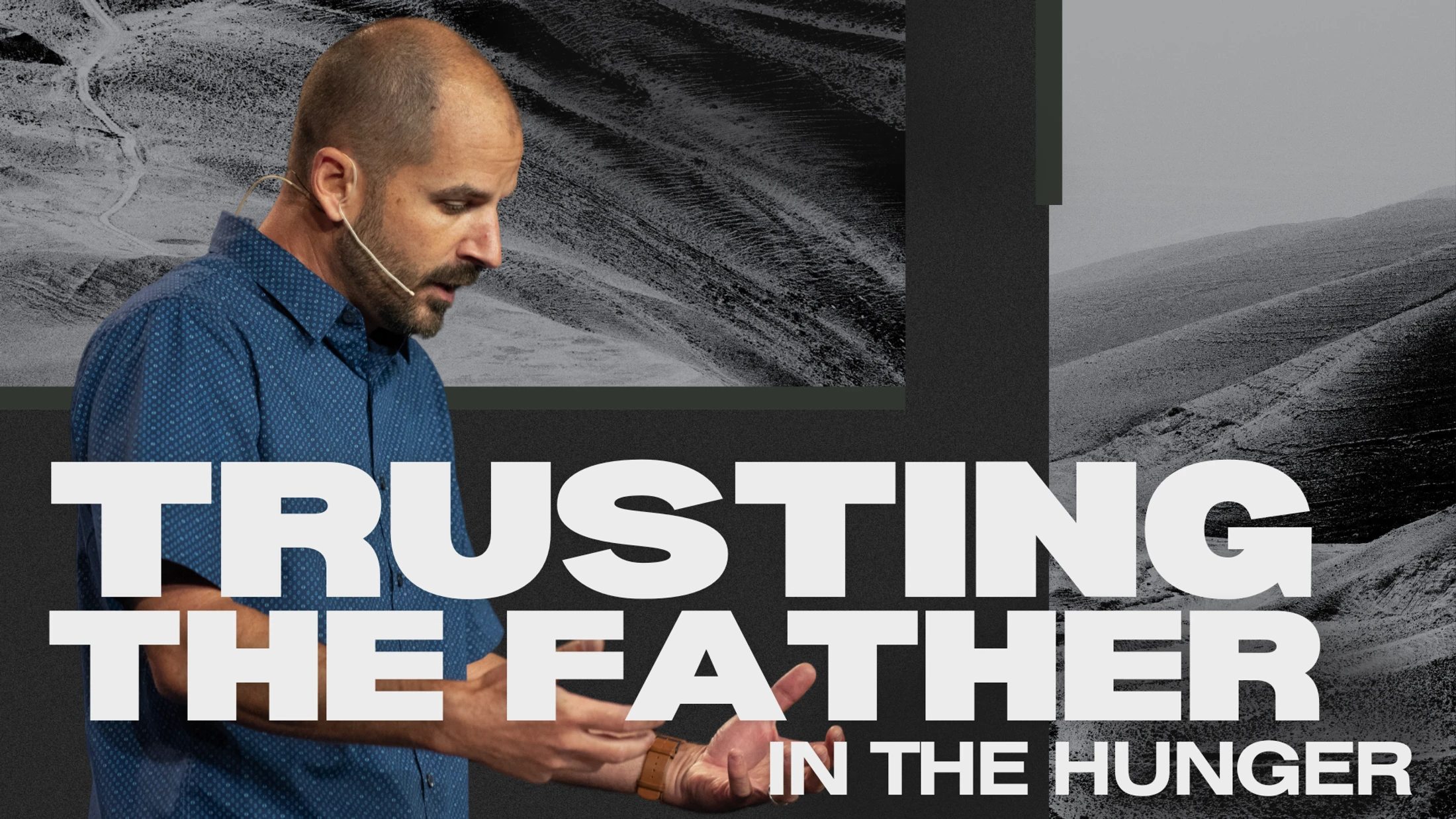
Well, good morning. It's good to be with you today. If we have never met, my name is Josh and I'm glad that you're here today. And I often say if you are new today, then you just walked into a room full of broken people who are just as in need of grace as you are. And we're just here seeking Jesus and pursuing him.
Our marriages aren't perfect. We have not figured out how to perfectly parent our kids yet. Our relationships are not perfect. We stumble and fall just like you. And so if that sounds like you, we welcome you and we hope that you feel welcome here as well.
If you've never connected with Whitewater any further than just attending a service, which is great. But if you haven't taken a next step, I want to encourage you to do that today. If you're ready to take a step, you can go out to the information desk in the foyer after the service and just introduce yourself to the team. They'd love to get you connected, help you find a way to share your gifts here at Whitewater and maybe get connected in community. But today we are starting a new series and we're just calling it Trusting the Father, a series that'll help us wend our way down the path to the cross and the resurrection.
And we'll focus in on four pivotal moments in Jesus life and ministry. Each of them was a crossroads for Jesus. A moment that after Jesus stepped onto the path that he could have stepped off of the path, but he stayed on the path, knowing that it would cost him. He stayed on the path, trusting the Father all the way to the cross. And today we'll look at the days right after Jesus baptism where the Holy Spirit leads Jesus into the wilderness to be tested or tempted for 40 days.
He's fasting for 40 days. Next week we'll look at the Garden of Gethsemane where Jesus is in prayer with his disciples, praying in agony. The night before he'll be crucified. Week three, we'll go into Jesus, go with Jesus to the cross, and that will be Holy Week. Holy Week is just that week that the International Church recognizes this path that Jesus took on this final week of his life.
And that week we'll have two extra experiences that we want to invite you into. The first is a special edition of Whitewater Eats. That's where we just come and share a meal together. It'll be Thursday evening at 6:30. We'll provide the main course.
And all we ask is that you will register on our events page. Let us Know that you're coming and bring aside to share. We'll share in communion together that night and just have a special moment where we kind of set our hearts up to look to the cross. And then the next day is Good Friday and we'll have a Good Friday service here in this room at 6:30pm if you haven't been to our Good Friday service, it is, it's a beautiful somber service. It's great for families.
So bring your kids. I really just cannot encourage you enough to come at 6:30 on Good Friday to come into this room. And it just does an amazing job of drawing the bow of sorrow and grief and the suffering that Christ went through to launch the arrow of, of our worship and celebration on Easter Sunday. So please make that a priority. And then there's Easter Sunday and we'll worship together.
We're just going to have two services at regular service time, so we anticipate a really full house. So get here early. And you also know, everybody knows Easter is the time of year that your friends and family and neighbors and co workers are all willing to come to church. So dream drag them along with you. I mean, invite them.
That's what I mean. Invite them. Invite them and invite them to come sit with you and they can hear the greatest story that's ever been told and celebrate in the Resurrection together. But the other thing that Easter brings, it brings a lot of guests and it brings all of our regulars who come every two to three weeks and they all show up at the same time. And inevitably, every Easter we have a higher need for volunteers to help out in two key areas, kids ministry and guest experience.
You might not know this. Those are the two most significant areas when guests come in that their kids and their families are welcomed and that they are brought into a beautiful, safe environment where they can learn about Jesus love for them. And so if you are willing, if you are able to serve just Easter Sunday, you might find out you like it and you might want to come back. But if you could go to the information desk in the foyer after the service, just let them know, hey, I'm willing to serve one of the services on Easter Sunday. That would be fabulous.
We could really use your help. What else am I missing? That's it. Enough announcements. Let's pray.
Heavenly Father, as we come to you today, I just thank you for your great love for us. I thank you for making a way for us to be in relationship with you through the life and the death and the resurrection of Jesus through this path. That was a Very difficult path. And as we start out on this path toward Easter, God, I ask that you would guide us along the way, that you would be our guide on this path, that you would help us to grasp the significance of the path of the Cross, that you'd lead us to powerfully rejoice in the empty tomb on Easter Sunday. Please pour your words through me today, Lord.
Make them like seeds that are planted for an eternal harvest today. Kingdom seeds that actually matter past this moment, past these seeds, and into our real lives. In Jesus name, Amen. You may have never taken the time to consider that Jesus life was lived almost entirely in obscurity. Like there's this big pomp and circumstance around his birth, angels and shepherds and the magi, and he's the Messiah and this big proclamation.
And then outside of a story when he's 12 years old, we know almost nothing about Jesus life, his early life, until he's about 30 years old. And it seems that Jesus just grew up like a normal kid, you know, like any regular messiah would. He worked with his dad as a tradesman. He had other siblings. And that's all about all we know about him.
Which is kind of crazy that the most significant person that's ever walked the planet. This is all we know about him until he's about 30 and he launches his public ministry. It's in this moment that Jesus goes public, that he steps out of obscurity and his whole life is on display. And he steps onto a path that he knows is going to lead to the cross. This is the path that we want to walk with Jesus on through this series.
The path from the wilderness to the garden, to the cross, to the tomb, to the resurrection. And at every juncture, as I said in the intro, every split, Jesus could have stepped off of the path. In fact, there was lots of temptation for him to step off of the path. But he stayed the course. He stayed on the path.
So let's start at the beginning of this path. With Jesus. It all starts at the Jordan river, where he's baptized by his cousin. You might know his cousin as John the baptizer or John the Baptist. Let's pick up in Matthew chapter 3, starting in verse 13.
Then Jesus came from Galilee to the Jordan, the river, to be baptized by John. But John tried to deter him, saying, I need to be baptized by you, and do you come to me? Jesus replied, let it be so. Now it is proper for us to do this to fulfill all righteousness. And then John consented.
As soon as Jesus was baptized, he went up out of the water, and at that moment heaven was opened and he saw the Spirit of God descending like a dove and alighting on him. And a voice from heaven said, this is my Son, whom I love, and with him I am well pleased. So Jesus public ministry starts at this moment. This is the switch that gets flipped. And there's a lot of interesting imagery and parallelism that's wrapped up in this.
And when you know what you're looking for, it's easy to see these parallels between this moment and the creation account that we read in Genesis chapter one. And all of this parallelism is to set up this idea and to point to the fact that Jesus is launching his ministry and a renewing, a re creation is happening. That's what's on display here. Let's read in Genesis 1:1, in the beginning, God created the heavens and the earth. Now the earth was formless and empty.
Darkness was over the surface of the deep, and the Spirit of God was hovering over the waters. Now, there are a few elements to pay attention to here. There's water. The Spirit is present, God is speaking, and creation happens. And what is the Spirit doing hovering over the waters?
Now, that Hebrew word for hovering is the picture of a bird, a bird hovering over something. And the Holy Spirit is hovering over the waters at creation like a bird. Now, we won't get into all the details about all of these parallels and examples, but this is on repeat in the Bible. We see these themes in the flood story. We see them in the Exodus as God parts the waters and his people walk through the Red Sea.
We see it at the end of the Israelites, 40 years in the wilderness where God stops the waters of the Jordan river, right where Jesus is getting baptized. I mean, not the exact spot necessarily, but it's the same river, okay, but right there, and God stops the waters and they walk through the waters into the promised Land. We see it in the very example of baptism that's given to us all throughout the New Testament. Each time God speaks, the Spirit is present and there's a recreation, a restoration, a reconciliation that that comes through the water. Do you see all those pieces in Jesus baptism story?
God the Father speaks. The Greek suggests it's a literal audible sound that the people would have heard. And the Holy Spirit is described to be descending like a bird, like a dove hovering over the waters of Jesus baptism. And you don't have to strain to see the echoes of recreation running through this moment. God's doing something significant.
New life is coming, and he's making this point visually in the words that God the Father speaks. This is my son, whom I love. With Him, I am well pleased. These words establish firmly Jesus identity. Anybody that was wondering if this might be the Messiah up to this moment, if they are there, there is no mistake.
He is the Son of God. He is the promised Messiah. He is the one who will redeem all of creation. And Jesus identity is probably the single most significant piece to our Christian faith. If he's not who we say he is, who he says he is, then all of this is worthless.
We should just pack it up and go home. This is a really lame hobby. But if he is who he says he is, that changes everything. And we've got to start living like that changes everything. And of course, we have the benefit of lots more scripture that describes Jesus identity in even greater detail than those who were at his baptism.
Colossians 1:15. The Son Jesus is the image of the invisible God, the firstborn over all creation. For in him all things were created. Things in heaven and on earth, visible and invisible, Whether thrones or powers or rulers or authorities, all things have been created through Him. And for him, he is before all things, and in him all things hold together.
And he is the head of the body, the church. He is the beginning and the firstborn from among the dead, so that in everything, he might have the supremacy. For God was pleased to have all his fullness dwell in him and through him to reconcile to Himself all things, whether things on earth or things in heaven, by making peace through his blood shed on the cross. This whole story is one giant story. It's not the Old Testament and the New Testament.
It's not a bunch of different books smashed together. This is one giant story of God's redemption. So the heavens open up at Jesus baptism, and God proclaims for everyone to hear that Jesus is His Son. And this is a huge moment of establishing Jesus identity. And this matters because everyone from here to the resurrection is going to question his identity, even those closest to Him.
But Jesus knows who he is, and his identity has been firmly anchored here. And that anchor is going to help Jesus stay on the path. So immediately after his baptism, there's even more parallelism at play between this account and the creation account. In Genesis, God creates the whole earth and everything in it, and he creates Adam and Eve. Then he gives them only one, one boundary.
They can eat of all of the trees in the entire garden, except for one. And if they eat from that one tree, then they will die. And then we get to Genesis chapter three and another character shows up on the scene. Who is it? Come on.
Satan. Everybody's favorite Satan, the serpent. And right out of the gate, the very first thing out of Satan's mouth and is a question that both undermines God the Father and tests the obedience and the fidelity of Adam and Eve. Genesis 3:1. Now, the serpent was more crafty than any of the wild animals the Lord God had made.
He said to the woman, did God really say you must not eat from any tree in the garden? Of course. He twists God's word even in the question. And with that one question, did God really say. The first temptation to distrust the Father and to give in to self comes on the scene.
And as we all know, Adam and Eve are quickly deceived and they quickly stop trusting the Father and they step off of the path. They forget their identity. They give in to self indulgence. Now jump back to Jesus and his baptism story. Immediately after his baptism, the next day, seen in the book of Matthew, after this recreation moment, this pattern plays out for Jesus.
Matthew 4. 1. Then Jesus was led by the Spirit into the wilderness to be tempted by the devil. This is such a loaded sentence, such a loaded sentence. So let's break it apart a little bit.
So the Holy Spirit led Jesus. This is so interesting to me, especially in the context of the message from two weeks ago. If you remember, we were talking about self control and we were talking about inner dominion, this power inside of us. We said we're kind of like a sailboat. We can get that sailboat going, we can get the sails up, we can push off and we can get everything ready.
But the Holy Spirit, who brings the wind, who brings the power to push us in motion, and this word right here led, that word literally is to set sail. That's so interesting to me. Jesus was positioned with his sails up, ready, and the wind blew and sent him into the wilderness. Why? To be, quote, tempted by the devil.
Now this is like, this is troubling. It should be. If you're troubled. This is troubling, isn't it, to be tempted by the devil. Why would the Holy Spirit send Jesus into the wilderness to be purposely tempted by the devil?
That's wild stuff. Well, without getting into a three hour long discussion on the doctrine of Satan, the oversimplified version is this. Satan is allowed to and even leveraged by God like it's his job. This is a weird thing in the Bible to poke at stuff and see what comes out. Like that's God uses Satan to Poke at stuff and see what comes out.
Not just so that God can see what he's so proud of, but also so that we can see what comes out.
It's like a can that has a green bean label on the outside of it. And you use a can opener to open it up and see that there are actually green beans inside or not that there's something else inside. Now, this all lines up with our whole series on the fruit of the spirit. What comes out of us is what's inside of us. It's what's actually in our hearts.
So when Satan shows up on the scene with Adam and Eve and he pokes them, what comes out? Selfishness, disobedience, pride, ego. He does the same thing to Jesus. After 40 days of fasting, Jesus has gone without food for 40 days. He's hungry.
And Satan starts with the same tactic he used in the garden. Matthew 4, starting in verse 2, after fasting 40 days and 40 nights, Jesus was hungry. The tempter came to him and said, if you are the Son of God, then tell these stones to become bread. And you can hear this echo of question. Did God really say.
Did God really say that this is my son? Did God really say that you are the Son of God? He says, if you are the Son of God, then surely you shouldn't have to go without eating like you're the King of creation. Prove that you are who you say you are. Do a little magic trick.
Do a miracle. Give in to your hunger. Just turn these rocks into bread. How hard could that be for the creator of the universe? But Jesus doesn't take the bait.
Instead, he quotes Deuteronomy 8:3. Jesus answered, it is written, man shall not live on bread alone, but on every word that comes from the mouth of God. Now, this is way more than just simply quoting the right scripture. That it is that. It's at least that, but it's much more.
Jesus knows the whole context of what was going on in Deuteronomy chapter 8. In Deuteronomy chapter 8, this is right before the Israelites are about to cross the Jordan river into the promised land. This is after 40 years of wandering in the desert. Moses reminds them of what God's been doing. And this is just wild to me when we read this.
Deuteronomy 8, 2, 3. These are Moses words. Remember how the Lord your God led you all the way in the wilderness these 40 years. 40 years, 40 days to humble and test you, to tempt you, to test you in order to know what was in Your heart, whether or not you would keep his commands. He humbled you, causing you to hunger and then feeding you with manna.
That was this food that showed up in the morning. It was miraculous food for the Israelites, which neither you nor your ancestors had known to teach you that man does not live on bread alone, but on every word that comes from the mouth of the Lord. God speaks that he is the Son. And Satan says, if you are the Son, Jesus understands exactly what's happening. Whenever God starts something new, Satan shows up to poke at it and see what comes out.
This is what he does. Jesus says, hunger is not my problem, Satan. In fact, God wants me to practice hunger. That's why I'm here, so that I'm even more desperate and hungry for him. He trusts the Father, he stays on the path.
Satan pokes him, and the real stuff comes out. After this, the devil takes Jesus up to Jerusalem, to the top of the temple, the highest point on the temple. And he says, if you are the son of God again, throw yourself down, for it's written, he will command his angels concerning you and they will lift you up in their hands so that you will not strike your foot against a stone. Jesus answered him. It's also written, do not put the Lord your God to the test.
So Satan again questions whether Jesus is the son of God, if you are the Son of God. And then he pulls a dirty punch. He weaponizes scripture himself. He twists it again. Just like he twisted God's words in the garden, he tries to manipulate Jesus into a quick exit from the path.
See, Jerusalem is a crowded city. It's always been. And the temple around the temple would have been a super popular area for people to gather. And so if Satan and Jesus are there, at the top of the pinnacle of the temple, Satan knows that if Jesus jumps up off, he's too important for God not to save. And so he's offering Jesus an exit ramp.
He's basically saying, listen, if you're the Son of God, God's going to save you. So just take a shortcut, man. Go around the cross, go around the suffering, go around the hunger. Jump off, watch God save you. And then they'll all believe you.
Just jump, Jesus. Step off the path. Take the easy way. Fill your stomach. Avoid the cross.
If you are who you say you are, you'll be fine. And then Jesus uses scripture again. Not just scripture, but scripture in context of its original meaning. He talks about the time that the Israelites were thirsty in the desert. God says, I'm with you.
I'm taking care of you. But. But they're thirsty and they're running out of water and they're starting to question whether God is good, whether God is with them. He says to Satan, I know who my father is. I don't need him to perform a miracle to prove his faithfulness.
The hunger is the path, the suffering is the path. There are no shortcuts, so poke all you want. So Matthew 4 Again, the devil took him to a very high mountain and showed him all the kingdoms of the world and their splendor. All this I will give you, he said, if you will bow down and worship me. Satan's like, oh, come on, Jesus.
All you real we know you're not the Son of God, you're just a man, Every man that ever was. All they want is power and recognition and significance. And I can give you that. I can give you that. Just worship me.
Just once, step off the path.
Jesus said to him, away from me, Satan. For it is written, worship the Lord your God and serve him only. Then the devil left him and angels came and attended him. I love that sentence. I don't even entirely know what it means, but I think it's awesome.
Jesus says, knock it off, go away. And Satan has no choice but to leave. And then angels come and attended him. That's so interesting to me. Again, I don't know entirely what it means, but it's awesome.
I like that idea. And unlike what happened in the garden, when Satan pokes Jesus to see what comes out, all he finds is exactly what's on the label. He is the Son of God. Make no mistake. Some people believe that Satan did not know that this was truly the Messiah at this point.
But at this moment, after the poking is done, Satan knows for sure who he's dealing with, and he has no choice but to flee. There's so much happening in this moment, like identity, obedience, the echoes of Eden and all this parallelism, the weight of what's to come. But one thing I want to hone in on as we launch into this path towards the resurrection and as we finish up the sermon this Sunday, there's one thing in particular, one little thread I want to tug at. Because it's not just what Jesus did, it's also what God calls us to do, what Jesus invites us to do, too. I want to talk about fasting, about Jesus decision, God's decision to send Jesus into the desert to fast.
The Holy Spirit led Jesus into the wilderness, not just to be tested, but also to fast. And Jesus wasn't just fasting from something. He wasn't just fasting from food. He was fasting for something. He was fasting for spiritual power.
He was fasting for communion with the Father. He was fasting as a preparation for this ministry that was getting launched. Because fasting isn't just giving something up. Fasting is creating space to receive something greater by giving up something good. He was training his hunger not for food, but for the Father.
And the truth is, we stink at being hungry. We're terrible at it. We don't practice being hungry. Half of us are like, is it lunch yet?
We get hungry. All we have to do is open up the cabinet, open up the fridge, stop in the drive through, shove something in our gullets, and we're not hungry anymore, feel bored. Just scroll and scroll and scroll and scroll and scroll. We don't ever have to be bored. Feeling anxious.
Take something, drink something, eat something, go somewhere, distract it, just distract it so you never have to sit in the waiting, in the thirst, in the hunger. But this is what fasting does. It cultivates hunger on purpose instead of killing hunger. Fasting is the discipline of denying ourselves something good to awaken the desire for something greater. It's how we train our souls to hunger and thirst for God.
So starting tomorrow, Russ talked about this last week. We're inviting all of you, everyone in the room, everyone listening online right now, to enter into a church wide season of fasting and prayer as a way for us to kind of step onto the path with Jesus. This is how Jesus began his path to the cross. And we want to step on this path with him. Trusting the Father, denying ourselves, and walking in obedience.
I'm just curious, how many of you have ever taken the time to do some level of fast for a spiritual reason? Great. You're not superheroes, by the way. Everyone who wasn't able to raise their hand, or for those who raised their hand and lied, no shame. This is a beautiful thing, that there's nothing in our bodies that want to do this.
There's nothing in the world that teaches us to do this. We have to do it deliberately. So starting tomorrow, we're going to do this. Some of us will be participating in what's called the Daniel Fast. The Daniel Fast, in simplest terms, is if it doesn't grow, you don't eat it, and if it isn't water, you don't drink it.
That's very limited. Take a vegan diet and squash it way down. But if that's not something that you want to take part in. Maybe that's too much all at once. Maybe you can't do that for medical reasons.
I totally understand. So others might take part in fasting by giving up one meal a day or a couple days a week, not eating for 24 hours. Setting aside that time for prayer, time to be in the word, time to stir up hunger for the Father. Others may take a more traditional Lenten approach. Maybe some of you already have started this for Lent to cut out something meaningful or something that you love like sugar or caffeine or meat or chocolate.
Next week we're also inviting everyone to add to this food fast another layer of fasting. A fasting for our minds as well. A media fast from all non work related media and the goal is to cut out noise and open up space for God to speak and for us to be able to listen. Our Disciple Making team has produced a little half sheet resource for you. It's on the tables on your way out if you want to grab one.
We also have a digital copy on our Easter Landing page for everybody listening online right now. We'll drop a link in the comments below for you to be able to access that as well. Several years ago I took part in the Daniel Fast for the first time. 21 days of fruits, vegetables, season seeds, nuts and water only. It was brutal.
It was exhausting. I was starving for the first four days. My body was revolting. It was terrible. You should join us.
But I learned something. I learned something. I had never said no to myself so many times in a day when I didn't have to. No one was making me do this. I wasn't sinning to drink coffee in the morning, but my diet was so specific.
I had to say no to everything. I had to say no to a glass of milk. I had to say no to the mints on the receptionist desk on the way in. I had to say no to the donuts that somebody brought into the office. I had to say no to to my beloved morning coffee, which I love coffee.
It is the juice from heaven. It is. Jesus wants us to have coffee. I know he does. I think he had.
I'm guessing he had a French press. I'm telling you. But I had to say no. No. I chose to say no over and over and over and over and over.
You have not said no to yourself once today. Probably. We don't say no to ourselves for a whole month.
And here's what happened. The daily rhythm of no began to reshape me. It was reshaping me. It spilled into Every part of my life, it spilled into my prayer time, my devotion time, my thoughts, my physical health. It spilled into how I responded to all other temptation.
It's amazing how practicing no was so powerful. And I realized something. When you say no to something, you don't have to say no to. When you say no to food, you're not just getting hungry, you're getting stronger. You're getting stronger.
You're working out a muscle that you never have to work out. And fasting doesn't just break old patterns, it builds new strength. And yes, your body will revolt just like mine will. Your flesh will complain. Your energy will probably plummet for a few days.
But on the other side, man, there is. There's power, there's recreation, there's clarity, there's often breakthrough. And we're choosing to lead our church into this season of fasting and prayer and being in the Word during the season. Not because we're super Christians, that's not varsity Christianing.
Not because we're trying to coerce God into doing something that we want him to do. If I fast and I suffer for you, you'll do this for me. But because we believe that some spiritual and physical things are only happens, some breakthrough only comes through fasting, prayer, and being in the Word. Sometimes that breakthrough comes in the forms of things that we can see and experience. And sometimes it comes in the invisible things that we don't see at all.
But make no mistake, the Bible teaches that when God's people deny themselves and give in to him, sacrifice, pleasure, distraction, and actual physical food, God chooses to bless that. And he works in mysterious and miraculous ways through this. This is about submission. It's about self denial. It's about a bit of self imposed suffering and choosing to walk the path.
Step onto that path with Jesus. From fasting to feasting over this Easter season. And as we do it, here's what I want you to remember. Every single time you want to grab something to eat, something that you've said, I will not do this. Remember each time that Jesus had the opportunity to step off the path, he didn't.
He stayed on the path. And we don't have to go to the cross, we just have to go till Easter and then we get to eat whatever we want. So join us. I want to personally challenge and encourage you. If you've never fasted at all, take a little baby step.
If you fasted before and you feel like you can do that comfortably, take on this crazy Daniel fast. It's crazy. Join us fast. Expect God to move because he will. Jesus says this troubling thing in Matthew 16.
He says, Whoever wants to be my disciple must deny themselves, take up their cross and follow me. And this is our act of denying ourselves, taking up the burden of something and stepping on the path with Jesus. He's our example and being like him is our highest name. Jesus fasted before he preached one sermon, before he healed anyone or performed any miracle. Before he called a single disciple, he fasted.
That's how significant it was to him. That's where his ministry began. That's where recreation, reconciliation began. And maybe, maybe that's exactly how God wants to begin something new in us too. Will you pray with me, God?
Strengthen us to do what we don't want to do. Strengthen us to do what we feel like we cannot do. Help us to step on this path, to emulate Jesus, to open up space in our hunger and in our minds, to give space for you in Jesus name, Amen.